
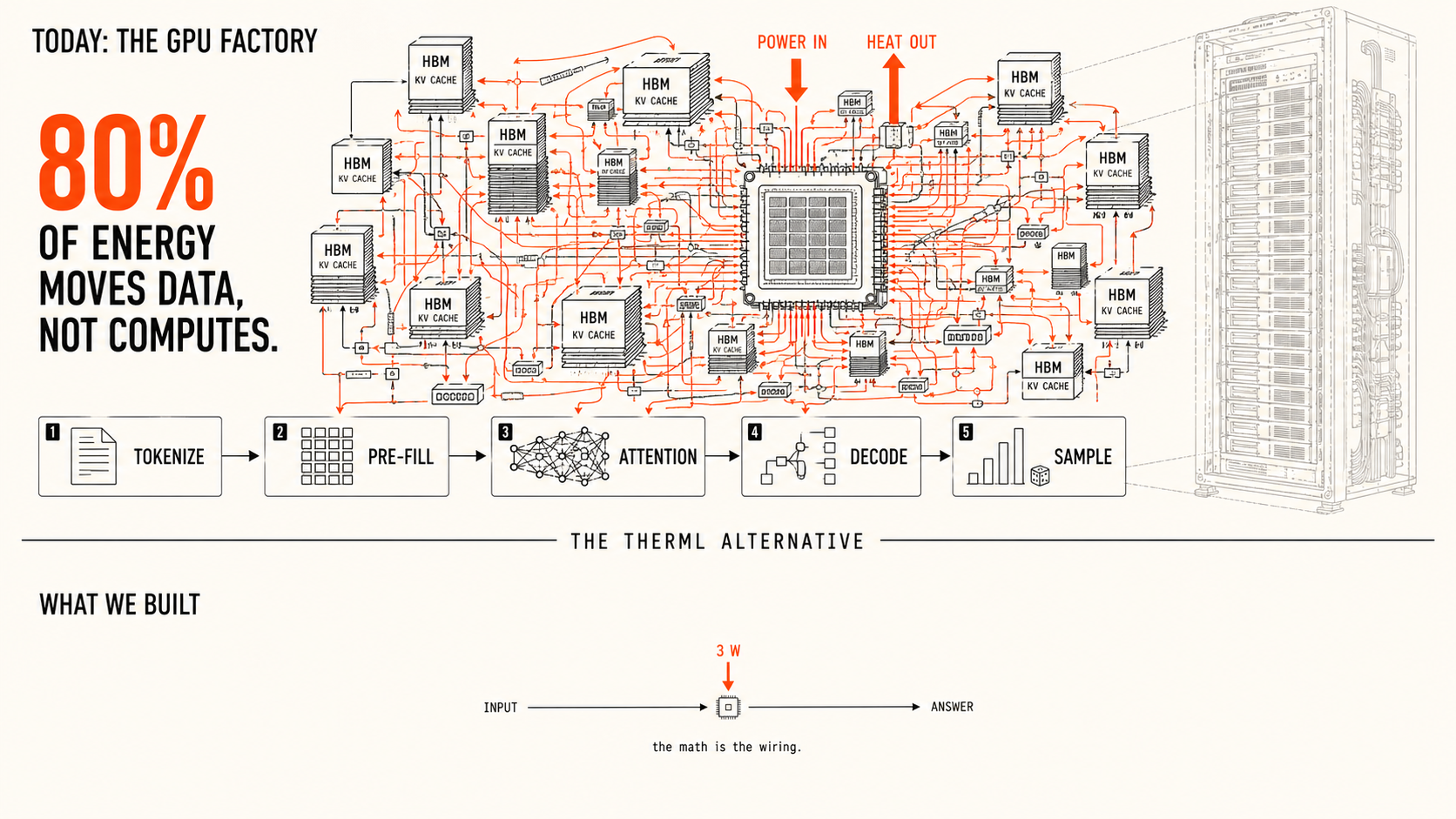
Today's GPU factory and the alternative we are building. Schematic by Therml.
The Hamster Wheel
Most of the electricity in an AI datacenter does not compute anything; it just moves numbers around. We are building a chip that does not have to.

Alex Morisse
Founder & CEO · April 25, 2026 · 3 min read
Somewhere outside Ashburn, Virginia, there is a building the size of a small town that exists for one reason: to answer your questions to a chatbot. It uses as much electricity as a city, and the cooling alone draws a small river through pipes in the floor.
When you type a question into the chat window, what happens inside that building is, on inspection, absurd. The building's job is to predict the next word in your reply, and it does this by looking up several hundred billion numbers from a row of memory chips, walking each one across a small piece of silicon, multiplying it by a different number, adding the result, and writing it back to memory. Then it does the same thing again for the next word, and the next, and the next, until the answer is finished.
Most of the energy is the walking. Eighty percent of the electricity inside that building does not compute anything; it just moves numbers around. Imagine a kitchen where the cook walks to the pantry, the fridge, the spice rack, and the dishwasher for every single bite of food they prepare. Most of the calories in the kitchen are spent on the walking, the food eventually gets made, and you would be hard-pressed to call any of it efficient.
This is not a temporary problem with a known fix. The way modern AI runs on the chips that exist today, the walking is the architecture. The industry has spent the last fifteen years getting the cooks to walk faster, each new generation of chip a faster cook, and the pantry is still the pantry and the fridge is still the fridge.
Everybody is making the hamster wheel faster.
What we are building
We are not making a faster hamster wheel.
We are building a chip where the math is the wiring. There would be nothing to fetch and nothing to walk to, because the answer is not assembled out of numbers shuttled through memory; it is what the chip does when you give it a question. The walking is gone by construction, and most of the electricity that used to move data would not need to move at all.
We want to be straight about where this stands. The mathematics runs today in simulation, the architecture is still in active research, and there is no fabricated chip yet, so we are not going to quote a wattage as if we had measured one. What we can say is that the physics of the architecture removes the data movement that dominates the energy bill, and that is the part of the bill, roughly eighty percent of it, that a faster cook can never escape.
If the architecture delivers what the physics suggests, the consequences are not subtle. The Virginia datacenter the size of a town becomes an appliance the size of a closet, the things ChatGPT does today move onto your phone without a server round-trip, and a satellite small enough to launch on a rideshare carries its own inference instead of beaming data down to the ground and waiting for the answer to come back. Those are the stakes of the research, not a spec sheet, and we intend to earn them one measured result at a time.
The same design aims at another prize: silicon that trains itself, with no separate building where the model is taught before being shipped to the inference building, because the teaching and the answering would happen on the same substrate. The silicon is the model, and that is precisely the claim our current research program exists to prove or break.
Why it matters now
The world is currently planning to spend roughly six hundred billion dollars over this decade to build more of the buildings outside Ashburn. Inference demand is growing ten times faster than they can pour the concrete. There is no version of that race that ends with enough buildings.
We are not making the hamster wheel faster. We are getting off the wheel.